What can I do to help my child with anxiety?
Reading to your child can help reduce anxiety by creating a predictable, calming routine and providing a sense of safety and connection. Listening to a story encourages children to slow down, focus their attention, and temporarily shift away from worries or stressful thoughts. Stories can also help children recognize and name emotions, understand that difficult feelings are normal, and learn coping or problem-solving strategies through characters’ experiences. When reading is shared with a caregiver, the combination of a soothing voice, physical closeness, and positive attention can further support emotional regulation and strengthen a child’s sense of security.
books FOR Children feeling worried or anxious- Commissioned
Wilma Jean the Worry Machine
Wilma Jean the Worry Machine
Wilma Jean the Worry Machine

This story helps children understand and manage anxiety and excessive worry. Through Wilma Jean’s experiences, children learn to identify their worries, recognize how anxiety can affect their thoughts and bodies, and distinguish between problems they can control and those they cannot. The book introduces practical coping strategies while encouraging children to talk about their fears, challenge anxious thinking, build problem-solving skills, and develop a greater sense of control over their worries.
Hey Warrior (Anxiety)
Wilma Jean the Worry Machine
Wilma Jean the Worry Machine
This book that explains anxiety and the brain’s fear response in an approachable, reassuring way. It teaches children how the amygdala acts like a protective “warrior,” sometimes sounding an alarm even when there is no real danger. By understanding what happens in their brain and body during anxiety, children can learn to recognize anxious feelings, use calming strategies, and develop emotional regulation, confidence, and resilience.
The Whatifs
Wilma Jean the Worry Machine
When Worry Takes Hold
This story is about anxiety, worry, and the cycle of “what if” thinking. The story follows Cora as anxious thoughts begin to take over, imagining everything that could go wrong. With support, she learns to shift her thinking toward more hopeful possibilities and consider what could go right. The book helps children recognize anxious thoughts, practice cognitive reframing, build confidence, and develop healthier ways to respond to uncertainty and worry.
When Worry Takes Hold
When Worry Takes Hold
One night just before the lights went out, Worry snuck into Maya's mind. Worry grew bigger and bigger until there was no space left for anything else. Just darkness and fear. Join Maya as she finds Courage, through the form of a calming breath, and learns how to break free from Worry's hold.
Jimmy The Jittery Jitterbug
Jimmy can’t stop jittering, no matter if it’s morning, noon, or night. But things get really tricky when it’s Jimmy’s turn to read in front of the whole class. Uh-oh!
Kids experience big emotions, and sometimes those feelings can get a little overwhelming. This heartwarming story helps little ones face their jitters and shows them simple, comforting ways to manage worries like separation anxiety, social fears, and even being afraid of the dark.
The Invisible String

Most kids love hide-and-seek, but Camila just wants to hide. Hiding is what she does best when she worries, and she worries a LOT. What if... I can’t... I’m scared!
A class trip to the aquarium causes her worries to pile up like never before. But when an anxious classmate asks for help, Camila discovers that her heart is bigger than her fears
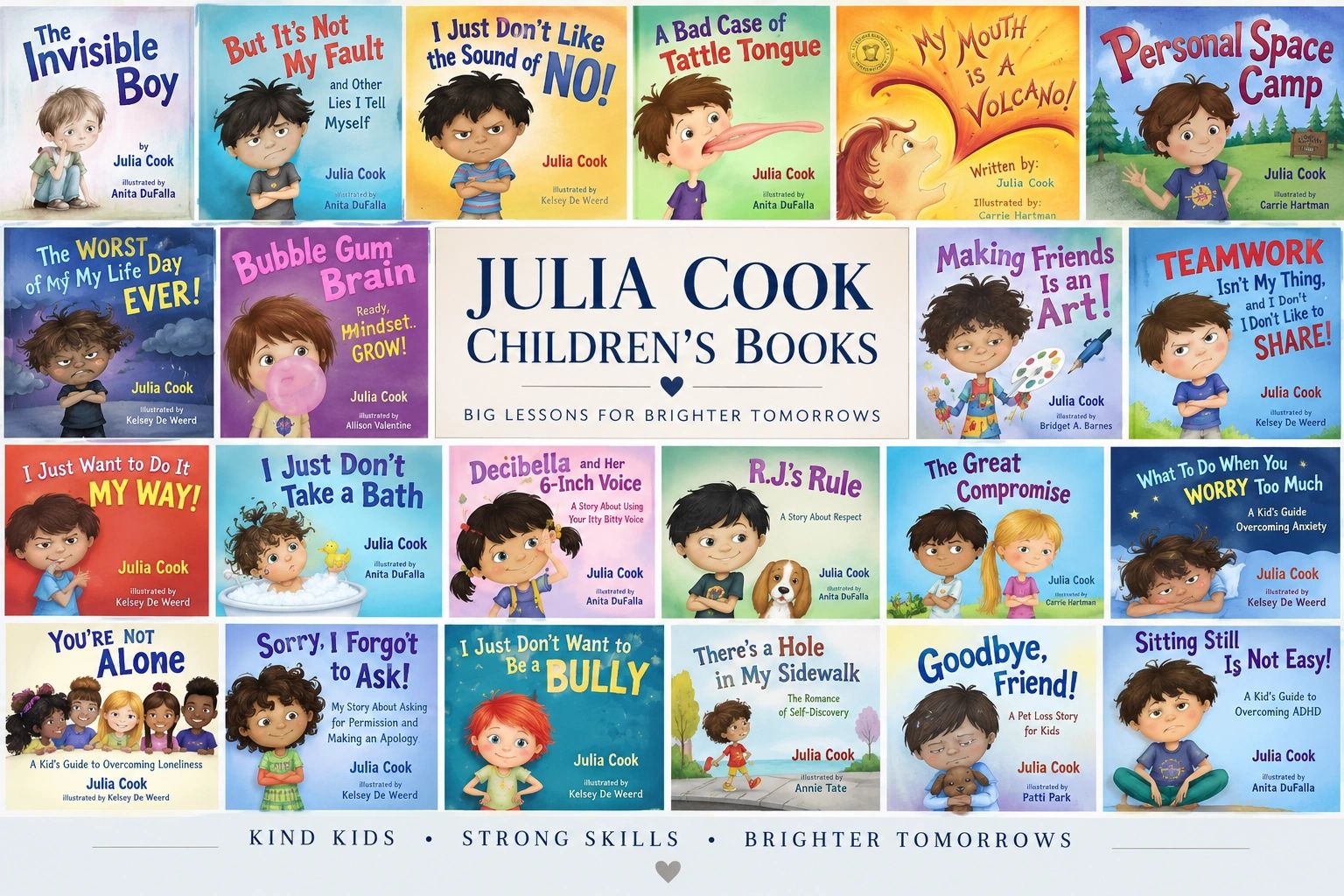
Kids of all ages love these books!
Julia Cook’s children’s books support social-emotional learning by helping children recognize emotions, understand how their behavior affects others, and develop practical skills for managing everyday challenges. Through relatable characters, humor, and age-appropriate situations, her stories teach important lessons about self-control, empathy, responsibility, communication, friendship, problem-solving, and making positive choices. These books also give parents a comfortable way to begin meaningful conversations and help children apply healthy coping and relationship skills in their daily lives.
stories that build foundations- Commissioned affiliate links
IMPULSE CONTROL
VIDEO GAME ADDICTION
VIDEO GAME ADDICTION
My Mouth Is a Volcano takes an empathetic approach to the habit of interrupting and teaches children a witty technique to help them manage their rambunctious thoughts and words. This story provides parents, teachers, and counselors with an entertaining way to teach children the value of respecting others, by listening and waiting for their turn to speak.
VIDEO GAME ADDICTION
VIDEO GAME ADDICTION
VIDEO GAME ADDICTION
Video game addiction is on the rise, but it can be prevented. This creative story book teaches both kids and adults how to switch out their game controller for a "life controller." Video gaming is becoming a part of our culture, and we must be strategic in creating a healthy gaming balance.
RESPONSIBILITY
VIDEO GAME ADDICTION
Teach children to stop making excuses and blaming others when they make mistakes. Elementary school kids will identify with Noodle as he makes one excuse after another for his behavior and choices that lead to unwanted consequences. By learning to accept responsibility he finds instead how to use mistakes as opportunities for problem-solving and to turn negatives into positives.
TATTLING
BEDTIME STRUGGLES
Parents who "battle the tattle" at home, on the playground, in the grocery store, or anywhere else can use this book to both entertain and enlighten their children about "The Tattle Rules." Every adult who desires to help children understand the differences between tattling and the need to warn others about important matters needs this book!
BEDTIME STRUGGLES
BEDTIME STRUGGLES
BEDTIME STRUGGLES
This book is a great resource to help children understand not only the consequences of telling a lie, but also how one lie can often lead to telling several more. It will help parents and teachers understand that lying can be a normal and sometimes healthy response for a child and offers tools to help guide children toward truthfulness.
PERFECTIONISM
BEDTIME STRUGGLES
BEDTIME STRUGGLES
This book helps children understand restlessness, impulsivity, attention, and self-regulation in a positive and relatable way. Through an engaging story, children learn that having lots of energy can make it difficult to sit still, focus, and think before acting, but that these behaviors can be managed with practical strategies. The book encourages self-awareness, impulse control, appropriate movement, and positive coping skills, while helping children recognize that they can learn to manage their energy successfully.
Books that build foundations!
Reading good books can have a meaningful influence on the emotional, social, and intellectual development of children and adolescents. Stories introduce young readers to characters who face challenges, experience difficult emotions, make mistakes, solve problems, and discover their strengths. Stories also give children a safe way to explore situations they may not yet have the words or confidence to discuss. Through these experiences, books can communicate positive messages about courage, kindness, perseverance, empathy, responsibility, and hope.

stories that build foundations- Commissioned affiliate links
IMPULSE CONTROL
SEPARATION ANXIETY AND CONNECTION
TEASING AND BULLYING

Jack's friend Charlie seems to know how to get away with just about anything. Adults always back down when you say you're sorry. But does an apology count if you don't really mean it? Jack learns that the path to forgiveness isn't always the easiest.
TEASING AND BULLYING
SEPARATION ANXIETY AND CONNECTION
TEASING AND BULLYING
A rare look at emotional bullying among boys from the best-selling author of My Secret Bully.D.J.'s friend Vince has a habit of teasing D.J. and then saying, Just kidding!" as if it will make everything okay. It doesn't, but D.J. is afraid that if he protests, his friends will think he can't take a joke. With the help of his father, brother, and an understanding teacher, D.J. progresses from feeling helpless to taking positive action, undermining the power of two seemingly harmless words
SEPARATION ANXIETY AND CONNECTION
SEPARATION ANXIETY AND CONNECTION
SEPARATION ANXIETY AND CONNECTION
Parents, educators, therapists, and social workers alike have declared The Invisible String the perfect tool for coping with all kinds of separation anxiety, loss, and grief. In this relatable and reassuring contemporary classic, a mother tells her two children that they're all connected by an invisible string. "That's impossible!" the children insist, but still they want to know more: "What kind of string?" The answer is the simple truth that binds us all: An Invisible String made of love.
RESPONSIBILITY
BEDTIME STRUGGLES
SEPARATION ANXIETY AND CONNECTION
Teach children to stop making excuses and blaming others when they make mistakes. Elementary school kids will identify with Noodle as he makes one excuse after another for his behavior and choices that lead to unwanted consequences. By learning to accept responsibility he finds instead how to use mistakes as opportunities for problem-solving and to turn negatives into positives.
BEDTIME STRUGGLES
BEDTIME STRUGGLES
BEDTIME STRUGGLES
This is a comforting children’s story about managing bedtime worries and focusing on positive thoughts. When Willa has trouble falling asleep because she is worried, her brother Willoughby helps her notice the happy, safe, and comforting things around her. The story provides a gentle way to teach children positive thinking, emotional regulation, gratitude, and self-soothing, while reinforcing the security and connection that can be created through a calming bedtime routine.
PERFECTIONISM
BEDTIME STRUGGLES
BEDTIME STRUGGLES
This story explores perfectionism, self-esteem, and social comparison. Through the story, children learn that someone who appears to have a “perfect” life may be experiencing pressure and struggles that others cannot see. The book encourages children to accept mistakes, develop realistic expectations, reduce unhealthy comparison, and recognize that their worth is not determined by being perfect.
INTRODUCTION TO PORN KIDS 3-8
INTRODUCTION TO PORN FOR CHILDREN 6-11
INTRODUCTION TO PORN FOR GIRLS 7-12
Young children deserve to be armed early against internet dangers. Good Pictures Bad Pictures Jr. makes it easy for parents to protect their young kids ages 3 to 8. Using gentle, age-appropriate messages, children will learn to Turn, Run & Tell when they are accidentally exposed to inappropriate content.
Written by best-selling author Kristen A. Jenson of the original Good Pictures Bad Pictures book, the Jr. version is a comfortable, effective way for proactive parents to empower their young kids with their first internal filter!
INTRODUCTION TO PORN FOR GIRLS 7-12
INTRODUCTION TO PORN FOR CHILDREN 6-11
INTRODUCTION TO PORN FOR GIRLS 7-12
Are girls more vulnerable to pornography than boys? Many experts say yes—yet girls are often left unprotected by the myth that they aren’t curious about porn or affected by it.
So how do you protect girls from pornography in today’s digital world? Start with conversations that build confidence, connection, and practical protection.
Good Pictures Bad Pictures Guide for Girls is a beautifully illustrated read-aloud book to help girls ages 7–12 stay safe, smart, and confident in a dangerous digital environment.
INTRODUCTION TO PORN FOR CHILDREN 6-11
INTRODUCTION TO PORN FOR CHILDREN 6-11
INTRODUCTION TO PORN FOR CHILDREN 6-11
Want a comfortable way to talk with your kids about pornography? Good Pictures Bad Pictures is a read-aloud story about a mom and dad who explain what pornography is, why it’s dangerous, and how to reject it.
Featuring easy-to-understand science and simple analogies, this internationally-acclaimed book engages young kids to porn-proof their own brains.
LETS TALK ABOUT CANCER
INTRODUCTION TO PORN FOR CHILDREN 6-11
This books helps families that want to reduce their kids' anxiety surrounding a scary diagnosis. It aims to empower kids with knowledge, which is proven to help kids through traumatic situations. Join Mia and her stuffed giraffe Stuart as they explain the science of cancer and how a loved one's diagnosis and treatment affects a kid's day-to-day life.
BRAGGING AND SELF-ESTEEM
Trudy Ludwig's children’s book about bragging, one-upmanship, self-esteem, and healthy friendship. The story follows Tyler, whose neighbor Jake constantly responds to Tyler’s accomplishments by claiming he can do them better. Over time, Jake’s competitive bragging causes Tyler to question his own abilities and feel inferior. With guidance from his uncle, Tyler begins to recognize that Jake’s behavior reflects Jake’s own need to prove himself—not Tyler’s worth or abilities ities
BULLYING
A story about relational aggression and emotional bullying within friendships. The story follows Monica as she struggles with a friend who excludes, manipulates, and embarrasses her while still claiming to be her friend. The book helps children recognize unhealthy friendship behaviors, understand that emotional bullying can be harmful even when it is subtle, and develop skills for assertiveness, boundary setting, seeking support, and choosing healthy friendships.

What can I do to build connection with my children?
Playing games with children provides opportunities to strengthen both connection and executive functioning skills. Shared play builds trust, communication, cooperation, and positive relationships with adults and peers. At the same time, games naturally exercise executive functions such as attention, working memory, impulse control, flexible thinking, planning, problem-solving, and decision-making
family game-Commissioned affiliate links
Five Crowns
Do You Really Know Your Family?
Get everyone together for an exciting card game of strategy and chance with this unique twist on the classic rummy card game and kings’ corner card game. The award-winning Five Crowns game is one of the best card games you can find for adults, teens, and kids ages eight and up.
Do You Really Know Your Family?
Do You Really Know Your Family?
Get ready to compete against your family to see who really knows each other best. Learn about each other and build new family memories as you answer interesting questions, spark conversations and perform silly challenges together. This card game will surely become a family game night favorite!
Classic UNO and Flip
UNO is a fast-paced card game that encourages attention, turn-taking, flexible thinking, decision-making, and impulse control. Players match cards by color or number while adapting to changing directions and action cards. In a therapeutic or family setting, UNO can also promote social connection, communication, frustration tolerance, good sportsmanship, and emotional regulation, making it an engaging way for children and families to practice important social-emotional and executive functioning skills.
Quiddler

Quiddler is a hit with all players, whether they’re word game enthusiasts or not! The perfect card games for families. EDUCATIONAL FUN - Enhance spelling, vocabulary, and critical thinking skills while having a blast!
Qwirkle
The Uzzle
Qwirkle is playable from early ages up, allowing young children and older individuals alike to develop and hone their spacial recognition, planning, and problem solving skills. Plan, win, and learn!
The Uzzle
The Uzzle
Sharp eyes, fast hands, and quick minds prevail in this fun-filled pattern-matching frenzy!
The Uzzle board game is great for enhancing problem-solving and many cognitive skills in children.
Spoons
Triangle Dominos
Triangle Dominos
Sharp eyes, fast hands, and quick minds prevail in this fun-filled pattern-matching frenzy!
The Uzzle board game is great for enhancing problem-solving and many cognitive skills in children.
Triangle Dominos
Triangle Dominos
Triangle Dominos
Sharp eyes, fast hands, and quick minds prevail in this fun-filled pattern-matching frenzy!
The Uzzle board game is great for enhancing problem-solving and many cognitive skills in children.
The Uzzle
Triangle Dominos
The Uzzle
A viral family tower game loved by kids and parents alike! Perfect for family game night, this fun and interactive activity brings everyone together for hours of laughter, bonding, and screen-free play.

OTHER HELPFUL RESOURCES:
Books can be valuable resources for individuals and couples seeking to better understand themselves, strengthen relationships, and develop healthier patterns of connection. The following recommended readings address common areas of growth, including marriage and communication, conflict resolution, codependency, boundaries, attachment styles, emotional intimacy, and personal development. These resources can complement the therapeutic process by providing practical tools, new perspectives, and opportunities for reflection and meaningful conversation outside of counseling.
Individuals and couples Commissioned affiliate lINKs
The Five Love Languages
The Five Love Languages- Military Edition
The Five Love Languages- Military Edition

In the #1 New York Times international bestseller The 5 Love Languages®, you’ll discover the secret that has transformed millions of relationships worldwide. Whether your relationship is flourishing or failing, Dr. Gary Chapman’s proven approach to showing and receiving love will help you experience deeper and richer levels of intimacy with your partner—starting today.
The Five Love Languages- Military Edition
The Five Love Languages- Military Edition
The Five Love Languages- Military Edition
In the #1 New York Times international bestseller The 5 Love Languages®, you’ll discover the secret that has transformed millions of relationships worldwide. Whether your relationship is flourishing or failing, Dr. Gary Chapman’s proven approach to showing and receiving love will help you experience deeper and richer levels of intimacy with your partner—starting today.
The Five Languages Of Apology
The Five Love Languages- Military Edition
The Five Languages Of Apology
True healing comes when you learn to:
- Express regret: “I’m sorry.”
- Accept responsibility: “I was wrong.”
- Make restitution: “How can I make it right?”
- Plan for change: “I’ll take steps to prevent a reoccurrence.”
- Request forgiveness: “Can you find it in your heart to...?”
Don’t let hurts linger or wounds fester. Start on the path to healing today and discover how meaningful apologies can make your friendships, family, and marriage stronger than ever before.
Codependent No More
The Language of Letting Go
The Five Languages Of Apology
Is someone else's problem your problem? If, like so many others, you've lost sight of your own life in the drama of tending to a loved one’s self-destructive behavior, you may be codependent––and you may find yourself in this book. Codependent No More helps you break old patterns and maintain healthy boundaries and offers a clear and achievable path to healing, hope, freedom, and happiness.
The Language of Letting Go
The Language of Letting Go
The Language of Letting Go
Problems are made to be solved, Melody reminds us, and the best thing we can do is take responsibility for our own pain and self-care. In this daily inspirational book, Melody provides us with a thought to guide us through the day and she encourages us to remember that each day is an opportunity for growth and renewal.
The Uzzle
The Language of Letting Go
The Language of Letting Go
Does your life feel like it's out of control? Perhaps you feel like you have to say yes to everyone's requests. Maybe you find yourself readily taking responsibility for others' feelings and problems. Or perhaps you focus so much on being loving and unselfish that you've forgotten your own limits and limitations. Or maybe it's all of the above.
Attached
The Body Keeps Score
The Body Keeps Score
• Anxious people are often preoccupied with their relationships and tend to worry about their partner's ability to love them back
• Avoidant people equate intimacy with a loss of independence and constantly try to minimize closeness
• Secure people feel comfortable with intimacy and are usually warm and loving
Attached guides readers in determining what attachment style they and their mate (or potential mate) follow, offering a road map for building stronger, more fulfilling connections with the people they love.
The Body Keeps Score
The Body Keeps Score
The Body Keeps Score
In The Body Keeps the Score, he uses recent scientific advances to show how trauma literally reshapes both body and brain, compromising sufferers’ capacities for pleasure, engagement, self-control, and trust. He explores innovative treatments—from neurofeedback and meditation to sports, drama, and yoga—that offer new paths to recovery by activating the brain’s natural neuroplasticity.
The Uzzle
The Body Keeps Score
The Uzzle
- Magnesium Oil Spray is known to reduce body aches, headaches, leg cramps, muscle spasms and menstrual pain.
- Magnesium Spray calms the body naturally to prepare for rest. This magnesium body spray offers numerous benefits to improve your rest.
- Hair, Skin and Nail Improvement topical magnesium chloride oil improves the he